Moisture and the Soil Under Your House
The dirt around Tallahassee doesn't deal with much freeze-thaw stress since our freeze risk is low. Instead, the biggest enemy of your foundation is usually water. When the soil gets saturated, it loses its ability to hold up the weight of your home. We see this constantly. Improper grading that slopes toward the house and bad gutters that dump roof runoff right next to the slab cause excessive moisture buildup near the foundation. That water has to go somewhere, and it usually ends up turning the load-bearing soil into mud.
Sometimes the water comes from inside. Leaky plumbing is a major contributor to moisture buildup that can worsen foundation problems over time. A slow drain line leak under a slab can wash out the soil for years before you notice a crack in the drywall. Before we install any steel, we look for these water issues. If you don't fix the gutters or the plumbing, the ground will just keep softening.
Diagnosing the Structural Damage
You can't fix a foundation by just looking at the drywall cracks. We need to know exactly how much the house has moved and whether the footings are still structurally sound. That means getting a professional assessment of the load-bearing elements before we ever put a shovel in the ground. A structural engineer foundation inspection typically runs between $400 and $1500. It is the only way to know for sure what the house needs, and it gives us the exact blueprint for the repair.
The engineer gives us a roadmap. They tell us where the soil has failed and how much weight each section of the perimeter is carrying. We use that data to plan the repair. We don't guess how many anchors you need or where they should go. We follow the math. This protects your home and ensures the repair actually holds the weight it's supposed to. If someone tries to sell you a major structural repair without an engineer's sign-off, they are guessing with your house. We prefer to measure, verify, and do the job once.
Anchoring the House to Solid Ground
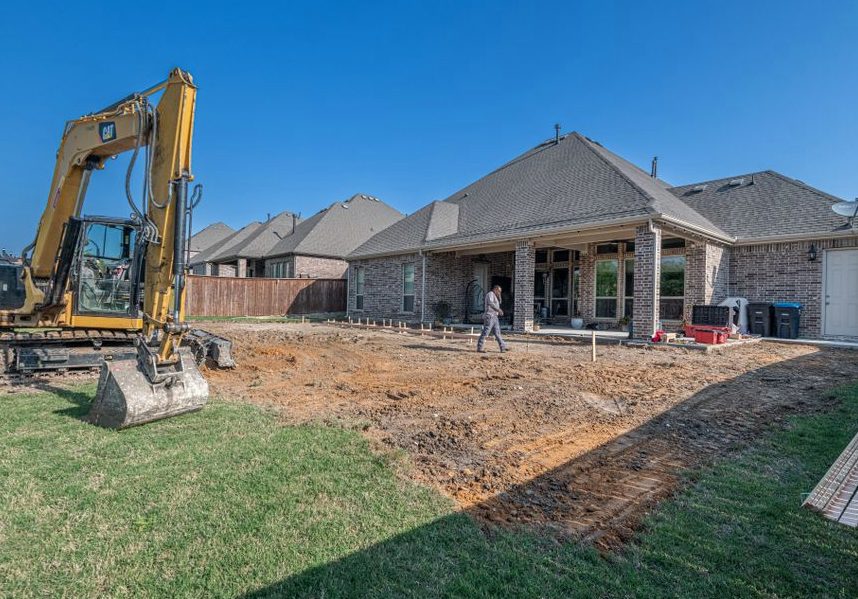
Once we have the plan, our crew starts digging to expose the bottom of your foundation footing. For lighter structural loads, we drive a round-shaft helical anchor deep into the earth. These look like giant steel screws. We spin them down past the saturated, weak surface dirt until they bite into dense, load-bearing soil. We monitor the torque the whole time so we know exactly when the anchor can support the house.
Then comes the actual lift. We attach heavy steel brackets to your footing and connect them to the anchors. We use a hydraulic ram lift to slowly raise the sunken section of the house. We don't just crank it up. The lift is recorded in 0.1-inch increments. We watch the brickwork, we watch the interior walls, and we measure the elevation constantly. Moving a house is slow, deliberate work. We bring it up a fraction of an inch at a time until the structure is fully supported and as close to its original level as possible.
Fixing the Concrete and Sealing the Cracks
Lifting the house closes up a lot of the cracks in your walls, but the concrete itself still needs attention. A cracked foundation wall is a weak point and a path for water. We handle this with low-pressure epoxy injection through staged surface ports. We glue small plastic ports along the crack, seal the surface, and slowly pump structural epoxy into the wall. The low pressure ensures the epoxy penetrates all the way through the concrete, welding the wall back together stronger than it was before.
If you have sunken slabs around the property, like a garage floor or a patio that dropped when the soil washed out, we bring in our high-density polyurethane foam injection rig. We drill small holes and pump the foam under the slab to fill the voids and lift the concrete back to grade. It's a fast, clean way to bring uneven concrete back into place without tearing it out and repouring.
Tallahassee Conditions That Matter
What working in Tallahassee actually means for the job:
Climate
- Annual heating degree days (base 65 °F): 1473. NOAA Climate Normals 1991–2020.
- Annual precipitation ~58.8 in. Rainy season June–September; wettest month June (~7.8 in), driest November (~3.1 in). NOAA Climate Normals 1991–2020.
- January avg low 40.5 °F. July avg high 92.1 °F. Seasonal range ~52 °F. NOAA Climate Normals 1991–2020.
- Annual cooling degree days (base 65 °F): 2758. NOAA Climate Normals 1991–2020.
Soil & Ground
- EPA radon zone: 3 (soil-gas indicator).
- Dominant soil: Foxworth (S). Moderately well drained. Source: USDA NRCS Web Soil Survey.
Local Notes
- Median home value $276,000. Source: U.S. Census ACS.
- Median household income $55,931. Source: U.S. Census ACS.
- Serving Tallahassee, FL and surrounding communities.
- Total population 199,696. Source: U.S. Census ACS.
What the Work Involves
A visual look at what the service involves.
From First Call to Finished Job
-
Reach Out
Tell us what you're seeing and when it started — you'll get a straight answer, not a sales pitch.
-
On-Site Inspection
A tech inspects the problem in person — no guessing from photos, no drive-by quotes.
-
Know the Price First
We put the fix, the timeline, and the number on paper — take your time with it.
Depending on what we find, that can mean:
- Push piers driven in sequence to refusal on a load-bearing stratum
- Torque-to-capacity correlation logged on every helical pier install
What It Typically Costs
Typical ranges, not a fixed price - the exact number is confirmed in writing before work starts.
$300–$600
$2200–$8100
Frequently Asked Questions
What causes foundation settling in Tallahassee?
In Tallahassee, settling comes down to the local ground conditions: EPA radon zone: 3 (soil-gas indicator). Dominant soil: Foxworth (S). Moderately well drained. Source: USDA NRCS Web Soil Survey.
How long does a typical foundation repair take?
A pier installation on an average home runs one to three days depending on access and the number of piers. Crack injection or slab leveling usually finishes in a single day.
Do I need to move out during the repair?
Most repairs are done from the perimeter or crawl space and don't require leaving home. For a large interior lift with significant floor disruption, staying elsewhere for a night can be more comfortable.
What is a manometer survey and why is it done first?
A manometer maps the floor's elevation across every room to show exactly where and how much the structure has settled. Without it there is no way to spec the correct pier depth or calculate how much lift to apply.
How much does foundation repair cost?
Nationally, most foundation repairs run between about $2,200 and $8,100, with an average near $5,100. A single push pier typically runs $1,500 to $2,500 and most homes need several, so larger pier projects reach the higher end.
Is foundation repair covered by homeowner's insurance?
A sudden structural event from a covered peril may be covered, but gradual settling from soil movement usually is not. Keep your inspection report and repair documentation for your adjuster.
Can I sell my home after foundation repair?
Yes. A documented, warranted repair usually reassures buyers far more than unexplained sloping floors. Most contractors provide a transferable warranty letter suitable for closing disclosure.
Other Things People Ask
How deep do foundation piers go?
There is no fixed depth. Piers are advanced until they reach soil or rock that can carry the load, which can be a few feet or more than thirty depending on the site. A soil bearing test sets the target before installation.
Will repair close the cracks I can already see?
Lifting a settled foundation back toward level closes most cosmetic cracks on its own. Any remaining hairline cracks are sealed once the structure is stable so they don't reopen.
Areas We Serve
Serving Tallahassee, FL. Call (448) 666-7478 to confirm coverage for your address.
Other Services We Offer
Why Tallahassee Homeowners Call
Need help today? Call (448) 666-7478.